
Can You Build an Extension Over a Drain Cover? What's Allowed and What Isn't
Updated: 11 minutes ago
Yes, you can usually build an extension over a drain, but you can't build directly over the cover itself, and the rules around it depend on who owns the drain. Drains come up on most projects we quote, from Kettering to home extensions in Northampton, so below is what is allowed, what isn't and what to do when a cover sits where you want the new wall.
Can you build an extension over a drain cover?
No, you can't build an extension directly over a drain cover or manhole. The cover provides access for drain maintenance and repairs, and burying it under a wall or slab is not permitted. You can, however, build an extension over the drain pipe itself, subject to a build over agreement with the water authority if the pipe is a public sewer.

Private drain vs public sewer: why it matters
Before anything else, work out whether the drain is private or public. This decides what approvals you need and how much paperwork the project carries.
Private drain: It serves only your property. You can build over it without a separate water authority application, but building control will inspect the works as part of your extension approval.
Public sewer: It serves your property and at least one other. To build within 3 metres of a public sewer, or within 1 metre of a public lateral drain, you need a build over agreement with the local water authority.
The easiest way to tell which is which is to look at the drain's route. If it passes through your land and then continues to a neighbour's property, it's public. If it starts and ends within your boundary, it's private. Water authority records exist but are often incomplete. A CCTV drain survey is usually quicker and more accurate.
What the rules say about building over a public sewer
Building Regulation H4 covers drainage, and any work within the protected easement around a public sewer triggers an application. The easement is usually 3 metres for pipes under 300mm in diameter (which covers most domestic drains) and 5 metres for larger pipes.
A standard build over agreement typically requires:
A CCTV survey of the drain before any work starts
Foundations to be set below the invert (the lowest internal level) of the pipe
Lintels where a pipe passes through a foundation, with compressible material around it
Pipes under a floor surrounded by pea gravel and capped in concrete
A second CCTV survey after completion, to prove no damage was caused
If the entire run of pipe within the build is replaced with new pipework during construction, the post-build CCTV survey isn't usually required.
What you can't do, even with permission
A few rules don't bend:
No building directly over a manhole or inspection chamber. The cover must remain accessible. If it sits where you want the wall, the manhole has to be moved.
No internal manholes on a public sewer. Any manhole serving a public drain must sit outside the building footprint, even after the extension is finished.
No junctions under a floor on a public drain. All branches from the new extension need to meet the public sewer in an externally accessible manhole.
No foundation running parallel to a public drain. The foundation can cross the pipe at an angle but can't run alongside it for any length. This often forces a tweak to the extension's footprint.
No starting work without the agreement signed off. If you build first and ask later, you risk being told to expose finished sections for inspection.
If you're planning a double storey extension, the foundation depth and load become more important still. The relationship between the new footings and the existing drain has to be worked out on paper before any concrete is poured.
What to do if the drain cover is in the way
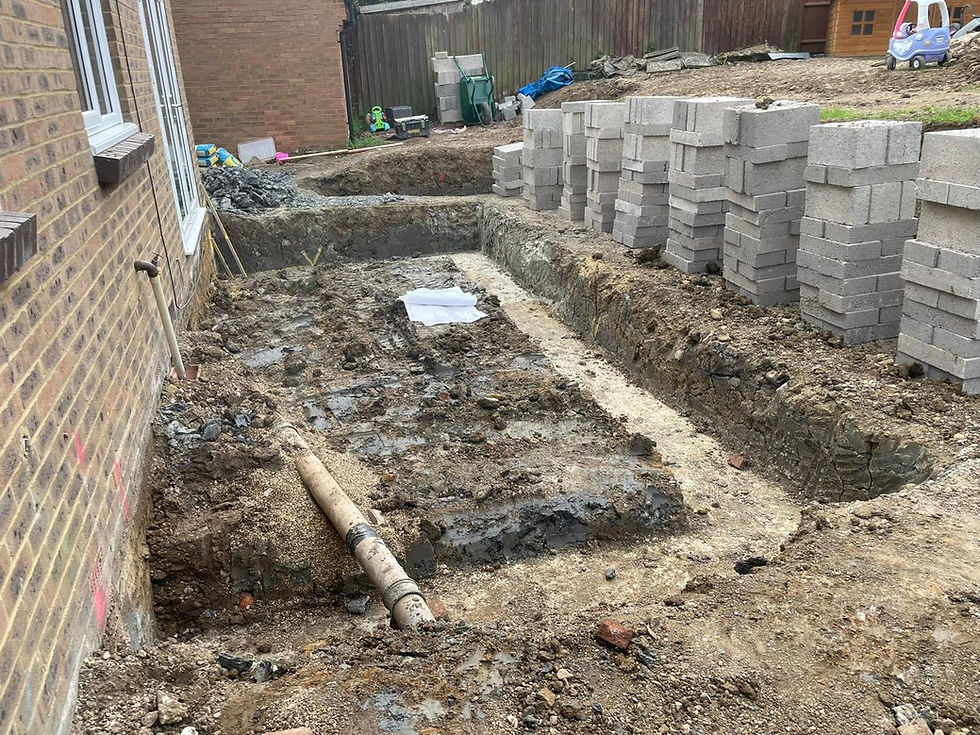
You've got three sensible options if a manhole or drain cover sits in the footprint of the proposed extension:
Move the manhole: With permission from the water authority, the manhole and a section of drain can be repositioned outside the new footprint. This adds cost but keeps the original extension design.
Build around it: Adjust the extension layout so the cover remains accessible outside the building. Usually the cheapest option if the footprint can be flexed.
Divert the drain: A 100mm or 150mm pipe is generally cost-effective to divert. Pipes over 300mm get expensive quickly, and the water authority may refuse to permit the diversion at all.
The order to do things in
For any extension where a drain or drain cover is in or near the footprint, the sequence is usually:
Commission a CCTV drain survey to establish the route, depth and condition of the pipework.
Confirm whether the drain is private or public, using the survey and the water authority's records.
Design the extension to either avoid the drain cover or include a relocation in the plan.
Submit the build over agreement application to the water authority, if a public sewer is involved.
Apply for planning permission and building regulations approval as you would for any home extension in Kettering or elsewhere in Northamptonshire.
Build, with the drainage works inspected by building control during construction.
Skipping any of these stages risks the council ordering work to stop, or asking for completed sections to be exposed for inspection later.
If a drain is sitting where you want your new extension, speak to our team. We can arrange the CCTV survey and handle the build over application as part of the project.

Comments