
10 Driveway Ideas for UK Front Gardens, and What Each Needs
Updated: 16 hours ago

The best driveway ideas start with the practical limits of your front garden: how many cars it needs to hold, where the water goes, and how the levels meet the house and the pavement. Get those right and the look is the fun part. As a team building driveways in Kettering, we see the same few details decide whether a good idea lasts. These ten ideas work on typical UK front gardens, each with the practical point that decides whether it will last.
Before choosing, measure the space. A parked car needs roughly 2.4m by 4.8m, plus room to open doors and walk past. A front drive over 5 square metres also needs to be permeable, or drain onto your own lawn or border, to avoid driveway planning permission.
1. Resin bound with a block border
A resin bound centre framed with a contrasting block paving border is one of the most popular modern looks. The border gives a crisp edge and holds the resin in, and the resin gives a smooth, permeable, weed-free surface.
Builder's note: the resin must go over a permeable base to count as permeable, and the border needs a concrete haunch so it does not move. The two materials behave differently over time, which is worth understanding when you weigh resin driveway vs block paving.
2. Herringbone block paving
Herringbone is the strongest block paving pattern for driveways because the blocks interlock in two directions and resist being pushed by turning wheels. It suits almost any house.
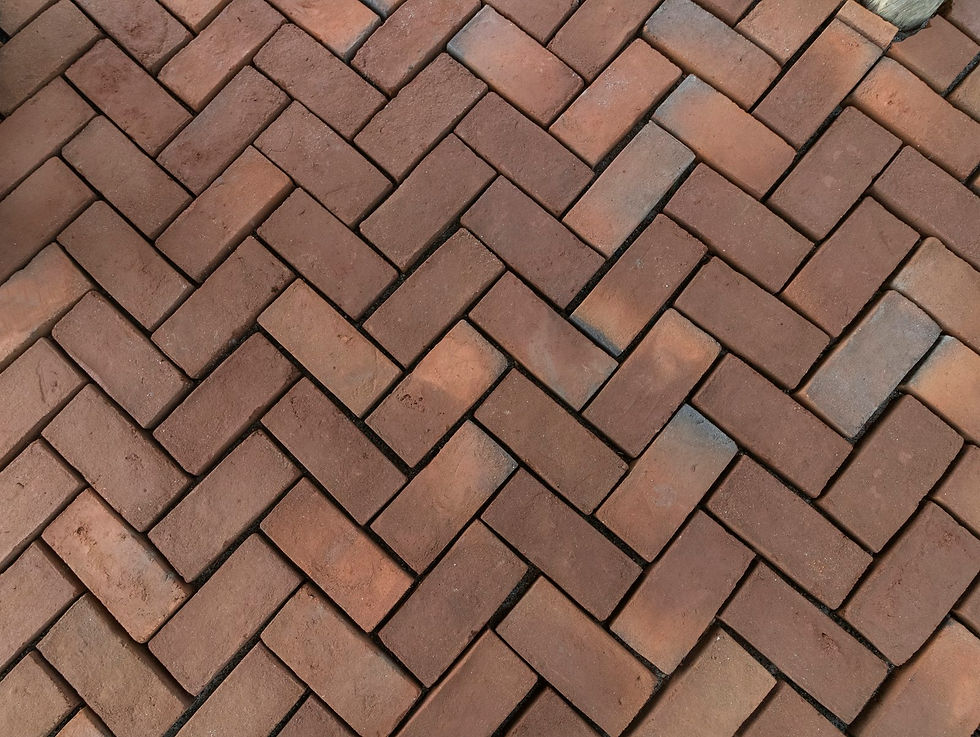
Builder's note: use permeable blocks, or design falls to a border or soakaway. Keep joints topped up with kiln-dried sand.
3. Gravel with a stabilising grid
Gravel gives a soft, traditional look and drains naturally. A honeycomb grid under the gravel stops ruts and makes it easy to walk and wheel on.
Builder's note: finish the first metre at the pavement in a hard surface so stones are not carried onto the footway.
4. Mixed materials
Combining surfaces breaks up a large drive: a block paved parking bay with a gravel margin, or resin for the parking area with setts marking the path to the door.
Builder's note: every change of material is an edge that needs restraining, and each surface needs to drain on its own.
5. A separate path to the front door
Many drives are just a wide slab that makes visitors walk between cars. A defined path in a different material, ideally with a gentle curve, makes the entrance obvious and the house more welcoming.
Builder's note: keep the path at least 900mm wide and level with the drive so there is no trip edge.
6. Planting pockets and a green edge
Leaving planting beds along the boundary or between parking bays softens a large hard surface, takes rainwater, and helps meet the drainage rule without extra drains.
Builder's note: shape the drive's falls towards the beds, and keep root-heavy trees away from the edge of the sub-base.
7. Grass reinforcement grids
For a second or occasional parking space, a plastic or concrete grid filled with soil and grass gives a lawn that can take a car without rutting.
Builder's note: it suits occasional parking, not a daily car turning on the spot, and grass struggles in deep shade.
8. Driveway lighting
Low-level lighting along the edges, in steps or around the path makes the drive safer at night and shows the surface off. Recessed ground lights, bollards and wall lights on the house all work.
Builder's note: plan cable runs before the surface goes down. Outdoor electrical work must be done by a qualified electrician and meet the wiring regulations.
9. Porcelain or natural stone at the entrance
A porcelain or sandstone apron where the drive meets the house or porch lifts the whole frontage, and ties in with a matching back garden patio (our patio ideas show how to carry a material through).
Builder's note: paving slabs are not designed for full vehicle loads unless they are the right thickness on a concrete bed. Keep them to walking areas or specify driveway-grade slabs.
10. Gates, piers and boundary walls
Brick piers with gates, or a low wall with railings, frame the drive and add security. Automated gates need power and space to swing or slide.

Builder's note: gates must not open over the pavement. Walls and fences next to a road used by vehicles are limited to 1m high without planning permission, one of the limits on how high a garden fence can be.
Practical checks before you choose
Levels. Keep the drive at least 150mm below the damp-proof course, and fall it away from the house.
Drainage. Permeable surface, falls onto planting, or a channel drain and soakaway.
Access. A new or wider opening onto the road needs a dropped kerb approved by the council.
Maintenance. Be realistic about sweeping, weeding and resealing. If low upkeep is the priority, resin is worth a look, given how hard wearing resin driveways are in daily use.
The house. Match the materials to the brick, roof and windows rather than copying a look from a very different house.
Driveway ideas: questions, answered
What is the cheapest driveway idea that still looks good?
A well-edged gravel drive with a grid and a hard strip at the entrance usually costs least and looks smart, especially on older houses.
What driveway lasts longest?
Well-laid block paving and resin bound both last many years. The sub-base and edging decide it far more than the surface you choose.
Can I combine the drive with the back patio?
Yes, and it often saves money. Using related materials front and back also ties the house together.
Bringing the ideas together
Most great drives are two or three of these ideas combined around a sound base and good drainage. We design and lay drives across Northamptonshire, and we can match front and back with new patios in Kettering or paving in Wellingborough. If you have an idea in mind, get in touch and we will tell you what it needs on your ground.


Comments